

No Matter

The State of Things
As I write this essay, Alice is up in Louisville for the St James Court Art Show. Customers keep asking her about Asheville, wondering whether the city is open.
That is, whether the city has recovered such that it’s again worth a visit. Whether what Asheville offers is worth a break from the turns of life.
A Series of Openings
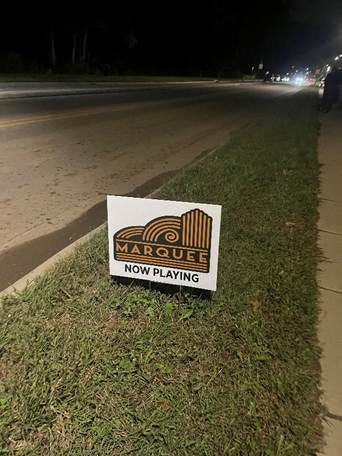
On September 25th, just before the year anniversary of Hurricane Helene’s Western North Carolina visit, Marquee became the first River Arts District business to reopen below the Norfolk Southern tracks.
That week, the valley and the city celebrated and mourned. A crew from Deutsche Welle was in town filming narratives as part of a documentary on climate disasters. On the 25th, they interviewed Alice after getting her name from Climate Watch, where she had told her story earlier this year.
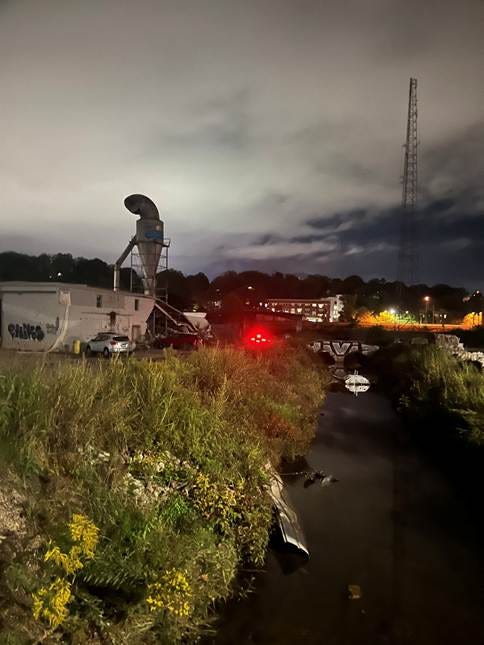
That evening, Alice and I drove to the Marquee’s opening. The River Art’s District was packed with subarus, circling the rotaries and looking for parking. We found a spot in the public lot across from Curve Studios and walked along Lyman, running parallel to the French Broad. The streetlights above the road and walkway also lit up the wreckage – in the earth, in the buildings. Fresh slabs of cardboard had been tossed over the fence at Asheville’s Waste Paper company, indefinitely closed after Helene. We imagined the tosser convincing themselves that some heroic recycler might still be inside, pulping and processing, no matter the state of things.
Along the branch, grasses and blooming golden rod covered the bank-stuck debris so that the creek, leading to a dark, double-sided graffitied culvert, felt like a passage out of apocalypse. Closer to the Marquee, we made our way through the broken parking lots and underneath crisscrossing caution tape, warning of exposed pipes, rubble, and voids.
Inside, the Marquee felt like another world. Brightly lit, crowds of people moved through the stalls of sculpture, paintings, prints, furniture, clothing, and creations unclassifiable. Alice remarked that there were more artists now and fewer antique stalls. No one who didn’t already know would have guessed the place had been flooded a year ago.
Almost right away, among the crowd, we saw the Deutsche Welle crew filming an employee, dressed in a clown costume, walking on stilts among the crowds. The crew asked us to stage a stroll down the corridor of stalls and we had to walk the walk a few times to get it just right.
We mingled and shopped, then went back out into the night, crossing again the tour of rubble and speculating about what else would reopen or shift.
Meanwhile, Chemical Romance stepped closer to its opening, finalizing permits from bureaucracies strained by so much rebuilding. And on the site itself, Jordan and Anna labored on finishing details. On Saturday, I went over to West Asheville to help prepare floating shelves for the waiting area’s partition wall.
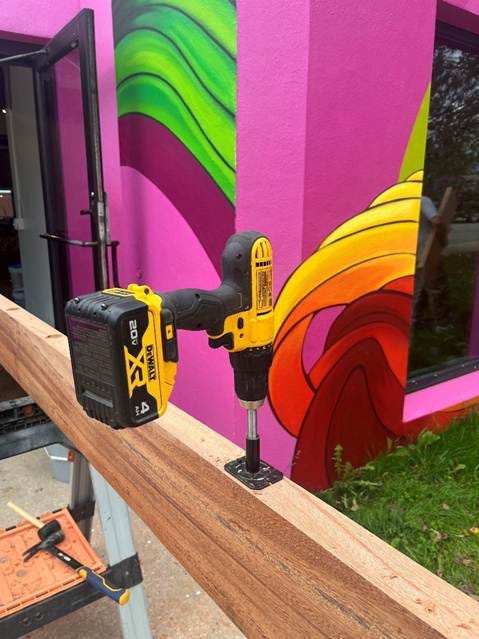
Jordan and I bored holes in some rosewood they salvaged at Scrounger’s Paradise. The bit was too thick for his corded drill so we faced the age-old construction dilemma: leave the site for the right tool or keep on with what you have?
We made do, set up out in the sunshine on Haywood Road, itself packed with pedestrians, cyclists, and subarus. Jordan made a jig for the holes. With cordless drills, we bored away, wrestling with the milled planks like we were drilling core holes in the solid earth. White smoke drifted out of the motor housing, zigzagging a few times before catching the breeze. We inspired knowing glances from passersby, those who knew our dilemma well or just knew better.
From the flat crest of Haywood’s mid-bend, we could see dark clouds mustering and rolling together from the north and west, like dough coming together. For a while, herald raindrops spit at us. We had time to move material and tools inside before the rainstorm took over the scene.
With the rain, I abandoned the work. I was making Alice a dinner, our own celebration amidst the celebrations. On my way out of West Asheville, I stopped by Locals Seafood at the WNC Farmer’s Market. I bought big eye tuna and oysters. Alice came over and we had a feast. Towards the end, we remarked how luxurious it felt and that maybe we were doing some disservice to the memorial weekend. But had Helene taken a different route to the Ohio Valley, then we would have spent a rainy weekend making food last year. So we were, in a way, completing the interrupted experience, a year later.
Or that’s what we told ourselves to put aside the question of what it means to celebrate with tragedy behind and tragedy ongoing.
The next day, I hiked into the Experimental Forest and made my way down to Bent Creek, then back up through stands of laurel, a pine forest, and slopes where hardwoods had fallen a year ago. The year has been steady with rainstorms and sunshine. Many leaves have fallen already from the canopy letting shuttles of light brighten green shades against the new yellows and browns of early fall.
I came upon a new tulip poplar growing at the base of a storm-struck oak and could see above in the canopy the fresh opening, the approximate shape of the fallen oak’s crown.
Walking along a low ridge on hard trail clay, I heard a snare-like pecking. I thought it must be a pileated woodpecker higher on the ridge. But closer to the trail was a long-dead pine that stood through the hurricane as it rotted in a vertical grave. A hairy woodpecker danced around the bough. When the bird saw me, they alighted to a maple and chirped in annoyance.
From the forest, the sky looked pale, almost like a winter’s day too cold for the sun. I thought of the sky in the days after the hurricane, how the vault flaunted a deep blue, like the hurricane was a spa treatment.
Or maybe it was just my perspective: then, the blue sky against the waste-covered earth and now, the blue sky against the lush forest.
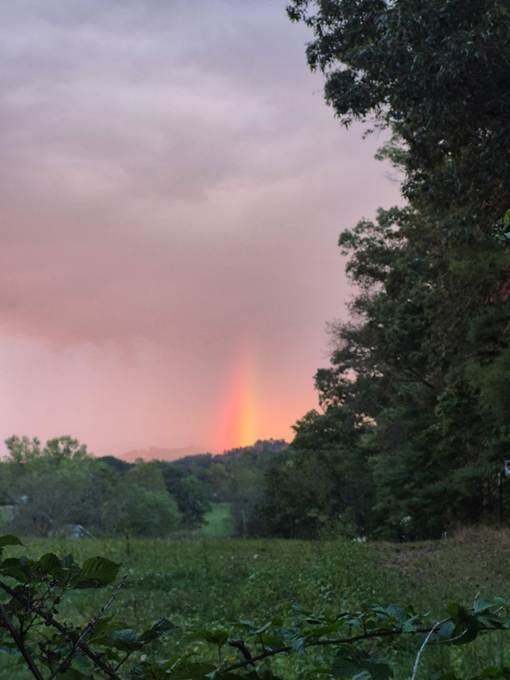
I returned home to find a text from Alice, who in her own day’s travel, had caught a rainbow making an opening in the clouds.
Conclusions
In some ways, Asheville is more open than it’s ever been. Isn’t authenticity what we want, as visitors or citizens, from our upcycled, mid-sized cities? Where else can you stumble and hop through a natural disaster’s wreckage on your way to an art gallery?
I always wanted to live by the shore and I think that desire kept me from understanding that I actually lived in a vacation town. A place people want to visit. A place I would want to visit if my life had taken different turns. And aren’t our visits, like oysters, brief respites from the crooked paths our lives take?
Just as Helene took no turns to spare the city or forest, my life took none to spare me. I am here and by the time my children are grown, I will have lived here most of my life. However I leave, by subaru or by box, I hope that the new tulip poplar outlives my stay and that it’s crown, like the dead oak before it, will in time make new shelter.
So follow the goldenrod through the rubble and note the spray-painted signs. Have a look at the dead trees and the new trees. Buy some art and watch your step. Get you some Asheville – where the best of time and space renews every day, beyond openings and closings.
“Heroic recycler” is from the Captain Planet pantheon?
Gorgeous!